DMX IPO Roadshow Launch Generates Significant Investor Interest - 1.4 Million-Plus Views Recorded
DMX conducted its IPO roadshow across Hanoi and Ho Chi Minh City on 27–28 May 2026, attracting over 12,000 attendees comprising investors, analysts, brokers, and press, with additional reach through concurrent livestream distribution.
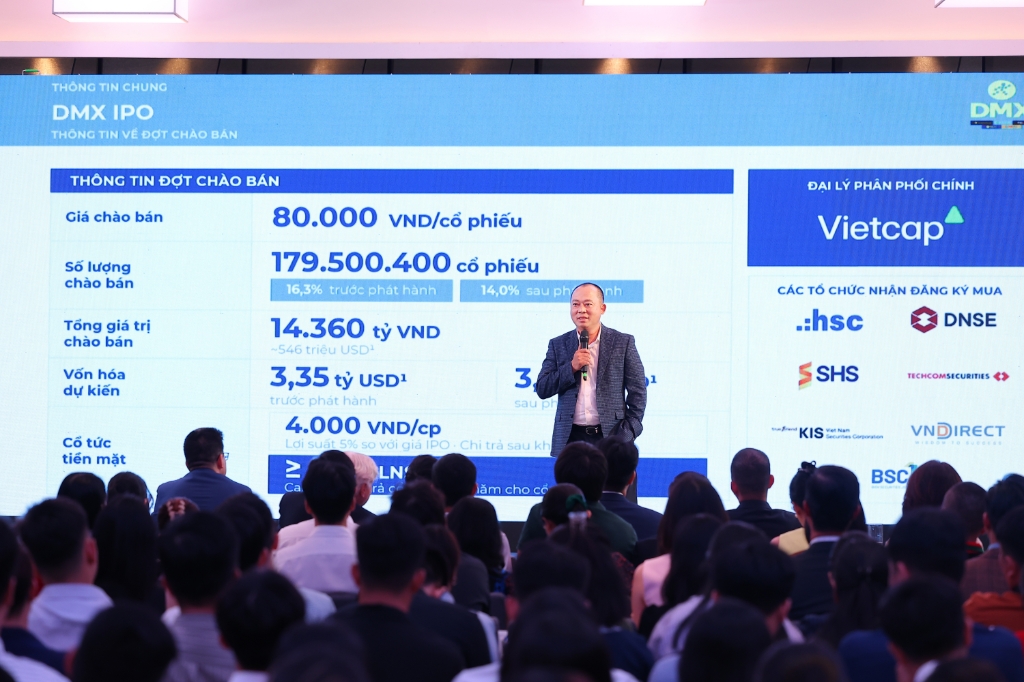
Attendance levels underscore the depth of capital market interest in what is among the most significant retail listings on Vietnamese exchanges in recent memory, supported by continued sector tailwinds across mobile and consumer electronics.
DMX IPO Price of VND 80,000: Undemanding Entry Point Against Long-Term Growth Trajectory?
DMX is offering 179.5 million ordinary shares at an IPO price of VND 80,000 per share, targeting gross proceeds of approximately VND 14,360 billion (USD 546 million). Post-offering charter capital is expected to increase from VND 11,013 billion to VND 12,808 billion, implying an estimated market capitalisation of approximately USD 3.9 billion. The listing on HoSE is anticipated in early August 2026.
DMX delivered a strong Q1 2026 result: total revenue of VND 32,718 billion (+30% YoY), with SSSG of 34% - entirely productivity-driven, with no contribution from network expansion. NPAT reached VND 2,219 billion (+50% YoY), with net margin expanding to 6.8%. At the end of Q1, DMX had already achieved 27% of its full-year revenue target and 30% of its full-year NPAT plan - a run-rate that positions the Company well ahead of its annual guidance.
Based on Q1 2026 outperformance, Vietcap Securities (lead adviser and primary distributor) projects FY2026 NPAT of VND 9,324 billion (EPS: VND 7,828), placing DMX's forward P/E at approximately 10x - a 30%-plus discount to the 14.2x regional Asian retail peer median. At the IPO price, DMX screens as materially undemanding relative to its growth profile and peer set.
The IPO price of VND 80,000 implies approximately 12x P/E on the original earnings plan - itself already below regional peer median. Should current growth momentum be sustained, further valuation re-rating is supported, underpinned by DMX's approximately 80% contribution to MWG group profit and a well-defined set of medium-to-long-term growth catalysts.
4M2026 results reinforce the Q1 trajectory: total revenue of VND 43,436 billion (+32% YoY), with SSSG sustained at 33%. At 35% of the full-year revenue plan completed through April - approximately 9% per month - the run-rate points to consistent execution rather than front-loaded outperformance. The data supports a durable growth profile, not a single-quarter anomaly.
At the roadshow, CEO Doan Van Hieu Em made his valuation view explicit: "For a billion-dollar market cap company with over 50% market share and a net margin of around 7%, a P/E of approximately 10x is very low. VND 80,000 per share is significantly undervalued."
Against a backdrop of market saturation concerns, DMX has repositioned from price-led competition to a solutions-based model - anchored by instalment financing, where the Company holds approximately 80% ICT/CE market share, and an expanding customer lifecycle service portfolio. Incremental growth vectors include DMX Technician, e-commerce, and the EraBlue Indonesia operation.
Management has guided for approximately 70% revenue growth and a doubling of NPAT by 2030. Allocation of IPO proceeds to debt repayment is positioned as a balance sheet optimisation measure, reducing financing costs and underpinning the DMX long-term growth capacity.
Insider alignment is unambiguous: management and founding shareholders are subscribing directly in the offering. CEO Doan Van Hieu Em has reallocated personal assets from MWG to DMX; Chairman Nguyen Duc Tai is participating entirely with personal funds; other senior executives have indicated equivalent intent. This level of insider participation is the strongest available signal of management conviction in the long-term investment case. The IPO serves objectives beyond capital raising - enhancing corporate transparency, expanding the institutional investor base, and establishing an independent market valuation. Standalone listing enables the market to assess DMX's consumer electronics earnings on a standalone basis, removing the conglomerate discount embedded in MWG's consolidated valuation.
Per CEO Doan Van Hieu Em, the post-restructuring model positions MWG as a pure holding company - focused on strategy and capital allocation - while DMX operates as an independent legal entity with direct ownership of the thegioididong.com, DMX, TopZone, and DMX Technician chains.
On the question of perceived conflicts of interest, CEO Doan Van Hieu Em drew a clear distinction between the two entities: MWG is a long-term, diversified holding platform; DMX is the direct ICT and CE growth vehicle. Participation in the DMX IPO represents alignment with a new growth cycle, not a reallocation of conviction away from MWG. His core valuation message was direct: DMX should not be benchmarked against MWG. The relevant comparison is DMX's approximately 10x forward P/E against regional consumer electronics and retail peers - on that basis, the current entry point is materially undemanding.
As of the roadshow date, DMX and Vietcap had completed pre-marketing engagement with over 300 institutional investors, receiving broadly constructive feedback - underpinning management's conviction in the investment case as presented at the event.
Strategic Transformation: From Retail Operator to Customer Lifetime Value Platform
CEO Doan Van Hieu Em has reframed DMX's strategic objective: from network scale to service quality across the end-to-end customer journey. Under the new model, the point of sale is the entry point, not the destination - value creation resides in the Company's ability to retain and monetise customer relationships over the long term.
The strategic transformation carries direct implications for competitive positioning. DMX is transitioning away from the promotional and price-led competition that has historically defined the consumer electronics retail sector, toward an integrated ecosystem model spanning consumer finance, after-sales services, and customer experience. This repositioning establishes DMX's core identity as a customer lifetime retailer - a structurally differentiated competitive position that is difficult to replicate at scale.
The strategy is structured around five pillars: productivity optimisation across the existing store base; consumer finance expansion, targeting an instalment penetration rate of 55–60% by 2030; after-sales service scaling through DMX Technician, underpinned by a multi-thousand technician network; Super App development from the existing customer application; and international expansion into Indonesia via the EraBlue joint venture with Erajaya.
The broader AI transformation of global retail reinforces the strategic relevance of DMX's CLV model. AI capabilities extend beyond operational efficiency and cost optimisation to enable hyper-personalisation at scale - product recommendation, demand forecasting, and after-sales service automation. These applications are most valuable in a CLV framework, where cumulative customer data compounds in value over the lifecycle. DMX's access to tens of millions of customer data points across the MWG ecosystem positions the Company to deploy AI as a structural CLV amplifier. The risk dimension warrants acknowledgement: the pace of AI development introduces ongoing requirements for technology and operating model adaptation.
The long-term implication is structural: DMX is not pursuing scale for its own sake but fundamentally reconstituting its value creation model - from product distribution to integrated technology consumption solutions. In an increasingly competitive and AI-disrupted market, this repositioning may represent the decisive differentiator underpinning durable long-term growth.
DMX's FY2030 targets are VND 182,000 billion in revenue and VND 13,000 billion in NPAT - implying a revenue CAGR of approximately 11% and an NPAT CAGR of approximately 16% over the plan period.
Five-Pillar Strategy: Initial Execution Reflected in Consolidated Performance
The distinguishing feature of this roadshow was evidentiary: the strategy presented was not forward guidance alone, but a thesis supported by 4M2026 actuals. All five pillars delivered positive growth - execution risk across the strategic framework has been materially reduced.
Pillar 1 - Productivity-Driven Growth: DMX delivered double-digit growth across all chains without network expansion: thegioididong.com +33%, DMX +30%, TopZone +39%. Critically, growth was broad-based across Apple, laptops, home appliances, and air-conditioning - not category-concentrated. Uniform category growth with zero incremental retail space is the clearest available proof that the productivity-over-scale thesis is executing as intended.
Pillar 2 - Consumer Finance: In 4M2026, instalment penetration increased from 35% to 38%, with segment revenue growing 48% YoY. The network of 3,000-plus transaction points is processing 25 million transactions totalling VND 37,000 billion. Consumer finance has structurally evolved from a conversion enabler into an independent growth engine - one that simultaneously expands addressable volume and generates higher margins than the core retail business.
Pillar 3 - DMX Technician: 4M2026 revenue of VND 1,252 billion (+60% YoY), with approximately 12% derived from third-party customers outside the ecosystem. The external revenue contribution remains early-stage but directionally significant - it evidences the emergence of an independent, captive-cost service revenue stream, with meaningful margin upside as the existing technician network and operational infrastructure are more fully utilised.
Pillar 4 - Super App: 4M2026 metrics of VND 2,460 billion in revenue and 58 million sessions place the Super App at an early but measurable stage of development. The investment case rests on forward potential: in-app commerce penetration remains low, and DMX is actively repositioning the platform from a retention and engagement layer into a primary transaction channel - a transition that carries significant revenue upside at current traffic levels.
The platform's expansion trajectory is taking shape: from closed, intra-ecosystem distribution toward third-party partner access. Executed successfully, the Super App has the potential to emerge as an independent transaction platform - one that augments retail revenue with platform economics and supports a valuation re-rating beyond the core retail multiple.
Pillar 5 - EraBlue Indonesia: 4M2026 delivered near-doubling revenue growth (+94% YoY), 20% SSSG, and network expansion to 222 stores, against a stated target of 500 by 2027 and 1,000 by 2030. Per Vietcap, the structural appeal extends beyond the growth rate to Indonesia's market backdrop - assessed as more favourable than Vietnam's circa 2010: low competitive intensity, an underdeveloped modern retail channel, and an open market share opportunity.
Substantial Addressable Growth Opportunity Ahead
The offering comprises approximately 180 million shares at VND 80,000 per share, representing approximately 15% of post-offering charter capital - allocated 1% to ESOP and 14% to external investors. The book opened on 27 May, with HoSE listing targeted for early August 2026. At gross proceeds of approximately VND 14,360 billion, the transaction is among the largest IPOs on Vietnamese exchanges in the past five years.
DMX's pre-IPO market capitalisation of approximately USD 3.3 billion is expected to approach USD 4 billion post-listing, a threshold widely considered sufficient to support eligibility for VN30 index inclusion - a development that would broaden the institutional investor base and enhance secondary market liquidity.
Per IR Head Dong Quang Trung, DMX's prior operation as an integrated MWG division - without standalone financial reporting - limited the market's ability to accurately price the business. The IPO addresses this directly: standalone financial disclosure, independent governance, and management pipeline development are among the primary structural objectives. The listing also serves as a direct rebuttal to the market's saturation thesis on Vietnamese consumer electronics retail.
The domestic market offers substantial runway, driven by a structural demand shift from first-purchase to upgrade cycles - centred on AI-enabled devices, 5G, Smart Home ecosystems, and premium appliances. DMX projects the Vietnamese consumer electronics market to expand from USD 10 billion in 2025 to USD 15 billion by 2030, an approximately 50% increase. Regulatory tightening on smuggled and unreceipted goods represents an additional structural tailwind for formalised retail operators, disproportionately benefiting scaled, compliant chains such as DMX.
Post-restructuring, DMX consolidates its focus on ICT and CE, with near-full ownership of Thợ DMX enabling tight vertical integration of pre- and post-sale technical services. The Super App transfers to DMX under a refreshed brand and interface, operating under an open-platform model - accessible to both MWG ecosystem entities and third-party partners - with a clear commercialisation mandate. This structure positions the Super App as a platform asset rather than a captive retail tool.
DMX holds a 45% interest in EraBlue and has guided for 70% revenue growth and NPAT doubling over the 2026–2030 plan period, underpinned by five growth pillars: existing network productivity optimisation, consumer finance scaling, DMX Technician expansion, Super App development, and EraBlue acceleration in Indonesia.
EraBlue is positioned as DMX's second home market. Since entering Indonesia in 2022, the chain has achieved market leadership in electronics retail through a street-front store format and same-day delivery capability - a structural differentiator against competitors whose lead times run 10–15 days. Per Vietcap, Indonesia's current market conditions are more favourable than Vietnam's circa 2010, with growth potential assessed as potentially exceeding DMX's own early-stage performance - a meaningful benchmark given DMX's subsequent trajectory.
EraBlue's growth case for DMX is underpinned by two structural advantages. The first is Indonesia's market opportunity: a population approximately three times Vietnam's, with an estimated 90% of consumer electronics retail still concentrated in traditional channels - implying a modern retail conversion opportunity of significant scale, amplified by an underdeveloped after-sales service market where DMX's CLV model is directly applicable.
The second structural advantage is operational: the DMX-Erajaya partnership combines DMX's retail systems and CLV expertise with Erajaya's local market knowledge, producing a compact street-front format with competitive pricing and a differentiated after-sales proposition - same-day delivery and installation, flexible returns - that competitors have not replicated at scale.
Subscription and Allocation Schedule
The subscription window runs from 27 May to 16:00 on 17 June 2026, with a 10% deposit required at the time of application. Allocation results are expected on 18–19 June, with settlement of the remaining balance due 22–29 June 2026. Subscriptions may be lodged via the Vietcap app or website; receiving agents are HSC, DNSE, SHS, TCBS, KIS Vietnam, VNDIRECT, and BSC.