DMX Completes Full-Year Profit Target In 9 Months, Q3 Profit Doubles
The business landscape for DMX in the first nine months of 2026 continued to record a strong breakthrough, with revenue reaching nearly VND 100 trillion and net profit after tax exceeding VND 7.7 trillion.
For the first nine months of 2026, DMX achieved a net profit after tax of over VND 7.7 trillion, up 83% year-over-year (YoY), successfully fulfilling its full-year profit target. Revenue reached nearly VND 100 trillion, an increase of 25% (29% on a like-for-like [LFL] basis), completing 81% of the annual target.
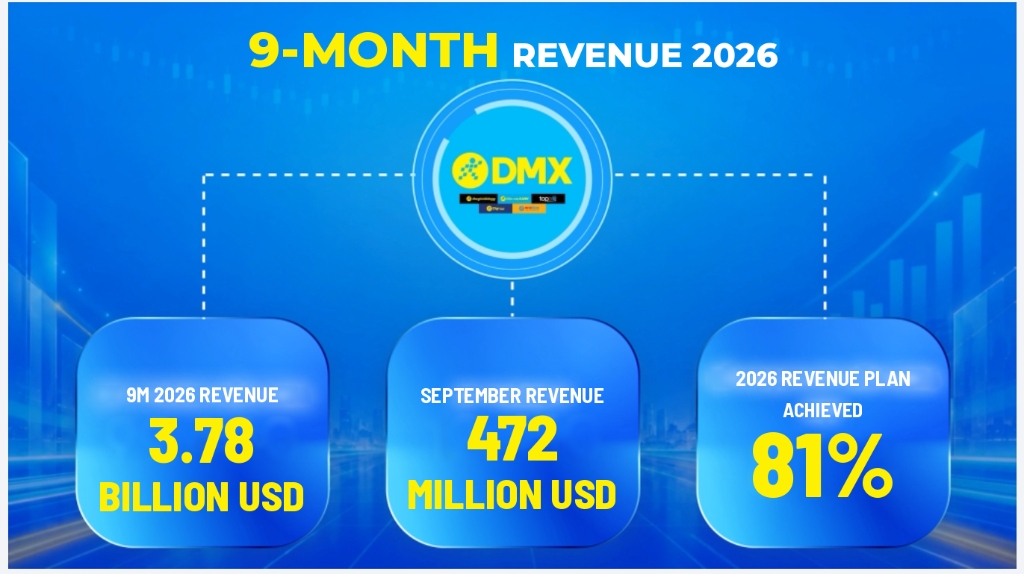 DMX - 9M 2026 Business Results
In the third quarter alone, revenue reached VND 34.180 trillion, up 22% YoY (27% LFL) and 4% quarter-over-quarter (QoQ); net profit after tax exceeded VND 2.8 trillion, doubling YoY. The net profit margin reached 8.3% in Q3 and 7.7% for the 9-month period.
Market Growth Driven by Pricing; DMX Growth Driven by Purchasing Power
According to the General Statistics Office, total retail sales of consumer goods and services nationwide grew by 13% in the first nine months, or 8% excluding the inflation factor (price effect). Specifically, the mobile phone and consumer electronics sector grew by 23% in value and 7% in volume (according to GfK Vietnam), primarily driven by new device prices being 10% to 15% higher due to limited chipset supplies and the trend toward AI integration. DMX served as the primary growth driver for the entire industry's volume expansion, posting a Same-Store Sales Growth (SSSG) of 30%.
| Chain | 9M/2026 Revenue YoY | Total Stores At Period-End | YoY Change |
| TopZone | +34% | 86 | +1 |
| DIen May Xanh | +29% | 1,998 | -21 |
| The Gioi Di Dong | +29% | 919 | -9 |
| Total System | SSSG +30% | 3,003 | -29 |
From Quantity to Quality
According to the Management Board, the strongest growth driver stemmed from upgrade demand. Rather than relying on direct discounting, DMX focused on 0% interest installment plans and enhanced after-sales services. This empowered customers to upgrade—such as shifting from a VND 5 million phone to a VND 20 million phone—with virtually zero interest burden.
Positive results were further propelled by the following key growth drivers:
- Category Expansion: DMX expanded its portfolio of small home appliances, air conditioners, accessories, and online-exclusive products. Currently, sales of air conditioners increased by 50%; laptops, appliances, and accessories by 30%; refrigerators and washing machines by 25%; Android phones and services by 20%; and televisions by 15% YoY.
- TopZone and Apple Product Ecosystem: DMX’s Apple market share reached over 50%. The iPhone 18 launched in Vietnam on September 18, 2026, simultaneous with the US market. TopZone opened two large-scale stores at 181 Ham Nghi (HCMC) and 19 Dinh Tien Hoang (Hanoi) in Q3, remaining the fastest-growing retail chain with a 34% expansion.
- AI and Smart Home: Demand for AI PCs, laptops, wearables, IoT devices, and domestic service robots grew rapidly. Smart camera sales are projected to reach over 1.6 million units in 2026, an 80-fold increase compared to 20 thousand units in 2024; robotic vacuum cleaners are expected to exceed 200 thousand units, 4 times the 50 thousand units sold in 2023. House of Future, a showroom dedicated to AI, Robotics, and Smart Home solutions, will debut no later than Q1 2027.
 Robotics products showcased at the 2026 Extraordinary General Meeting of Shareholders of Dien May Xanh Investment Joint Stock Company.
Driven by a higher-value product mix, the Q3 gross profit margin exceeded 20%, up nearly 4 percentage points YoY. The benefits derived from legacy inventory price gaps were merely seasonal and negligible.
Store-Level Operational Optimization
Selling and administrative expenses remained virtually flat YoY, allowing nearly the entire gross margin improvement to flow directly into the bottom line. The ratio of administrative expenses to revenue in Q3 dropped to 2.4%, down 0.7 percentage points YoY and 1.1 percentage points QoQ.
These results were achieved through performance-linked staffing compensation—where sales employee earnings are directly tied to business outcomes—shifting store lease agreements to variable costs linked to individual store revenues, and flexibly adjusting the store network in response to objective factors such as road expansions or relocations to prime sites.
Installment Financing Boosts Consumer Purchasing Power
Installment plans currently account for 38% of DMX’s revenue. The company aims to increase this share to 45% in Q4 2026 and over 50% in 2027.
During the first nine months, the mobile and electronics sector grew 23% in value but only 7% in volume as new device prices were adjusted upward. Installment plans served as a crucial tool for DMX to sustain consumer purchasing power under these market conditions. Vendor subsidies—previously used primarily for direct cash discounts—have been reallocated toward 0% interest financing solutions. For high-value products, this approach proves much more effective than a minor price cut, enabling customers to choose devices that better fit their needs.
While consumers in heavy installment markets like the US still incur borrowing costs, customers at DMX enjoy financing costs close to zero.
This operational model relies on multi-party collaboration: manufacturers provide customer subsidies; major financial institutions and banks supply capital and credit assessment; and DMX connects all stakeholders through its workforce, system, and store network. DMX's benefits are captured via revenue-sharing arrangements with manufacturers, which are reflected in its gross profit margin—having risen by nearly 4 percentage points in Q3 2026 YoY.
 Installment financing boosts consumer purchasing power
Despite interest rate fluctuations during the first half of 2026, operating costs for installment packages remained stable thanks to close partnerships with financial institutions. All parties continue to coordinate efforts to enhance risk management and optimize costs. The Management Board expects the installment share to continue growing over the next five years.
Outlook and Dividends
Ending September inventory increased by 25% compared to the beginning of the year to prepare for the peak year-end and Lunar New Year shopping seasons. The Management Board projects full-year 2026 revenue to reach nearly VND 139 trillion (up 30%) and net profit after tax to reach a minimum of VND 10.0 trillion (up 64%), potentially exceeding VND 10.5 trillion supported by the Q4 seasonality.
In 2027, the ICT sector is expected to achieve double-digit growth driven by upgrade cycles for AI and Windows 11. Consumer electronics and home appliances, where DMX commands roughly 50% market share, are expected to grow at double digits or higher. Additional tailwinds stem from the regulation banning imports of used electronics effective January 2027 (all products at DMX are 100% brand new and genuine), parallel sales of multiple phone generations paired with trade-in programs, and the launch of House of Future (AI, Robotics, Smart Home) no later than Q1 2027.
With low CAPEX requirements relative to operating cash flow, DMX is committed to paying a cash dividend of at least 50% of annual net profit. The Extraordinary General Meeting of Shareholders on October 29, 2026, approved an interim dividend advance of VND 2,000 per share scheduled for December 2026, alongside a warrant issuance plan for the DMX Management Board tied to profit targets through 2030.
Financial results documentation and the Q3 2026 Q&A summary are available at: https://www.dmx.vn/eng/reports
This article contains forward-looking statements based on current expectations. Actual results may differ.