Dien May Xanh's Blockbuster IPO: Raising VND 14,360 Billion, Optimizing Cash Flow And The "Billion-Dollar" Customer Lifetime Value Story
Dien May Xanh Investment Joint Stock Company (DMX)'s IPO is one of the blockbuster deals kicking off 2026, with an estimated market capitalization of over VND 102,460 billion (USD 3.9 billion), promising a compelling "billion-dollar story" as the company transitions from a one-off transaction model to full Customer Lifetime Value (CLV)monetization. For investors, demonstrating the ability to generate recurring cash flows at high margins is the key inflection point that reframes how the market values the business.
According to the prospectus, the offering aims to enhance DMX's transparency, credibility, and brand recognition, while broadening access to diversified capital sources to support its growth strategy. The additional capital will also strengthen DMX's financial capacity and fund core business operations. If fully subscribed, the company expects to raise over VND 14,360 billion.
From selling products to selling a lifetime: Dien May Xanh and the "billion-dollar" Customer Lifetime Value story
Unlike traditional retail models where the customer journey ends at checkout, DMX has adopted a Customer Lifetime Value (CLV) approach. The company no longer views "selling a television" as an endpoint — it is the starting point of a continuous value-added service chain: installment financing, extended warranties, maintenance, cleaning, repairs, and beyond. Each service generates incremental revenue at progressively lower marginal costs, leveraging the existing infrastructure.
The numbers speak louder than words. At end-2024, DMX's short-term deferred revenue (primarily services sold but not yet delivered) stood at approximately VND 21.7 billion. By end-2025, this figure surged to nearly VND 537 billion, and continued rising to approximately VND 612.7 billion in Q1/2026 — driven largely by extended warranty packages, periodic maintenance, air-conditioner cleaning, and multi-year post-sale device care services.
According to the prospectus, the rollout of extended warranty packages led to a significant increase in deferred revenue balances at end-2025 compared to 2024. This reflects a structural shift in DMX's business model toward a higher proportion of after-sales service revenue, while improving cash flow predictability and creating a stable recurring revenue base for future periods.
Five engines converting one-time buyers into lifetime customers
The DMX prospectus reveals that the company continues to maintain a customer-centric orientation, while expanding its financial services and payment ecosystem to enhance the customer experience and increase revenue per point of sale. Rather than isolated initiatives, DMX has built an integrated five-pillar growth ecosystem revolving around the product lifecycle — operating like interlocking engines designed to keep customers within a closed consumption loop.
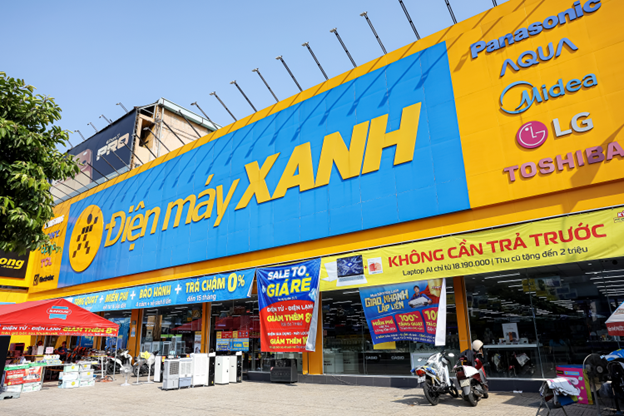
Operational Excellence — Superior growth from system depth
Rather than aggressive expansion, DMX is now focused on optimizing operational efficiency across its existing store network. The turning point came during 2023–2025, when the company decisively closed over 400 underperforming stores, formally shifting focus from scale to quality.
At remaining stores, floor space has been upgraded from storage-heavy layouts to an "experience model" to improve conversion rates. Simultaneously, DMX restructured the compensation model for nearly 34,700 employees from fixed salaries to performance-linked income, directly activating system-wide productivity. Big Data has been deployed across supply chain management, enabling more accurate demand forecasting and accelerating inventory turnover (improving from 4.2x in 2024 to 4.4x in 2025).
The result: DMX's net profit margin improved from 4.0% in 2024 to 5.3% in 2025, with net profit reaching a record VND 5,801 billion — up 56.1% YoY.
Demand activation through payment solutions and financial utilities
Under the old model, the customer journey typically began only after a purchase decision had already been made. Under the new model, the transaction begins the moment a customer starts evaluating their finances.
According to the prospectus, approximately 74% of consumers consider installment plans or consumer finance when purchasing high-value electronics. DMX eliminates friction by embedding buy-now-pay-later solutions directly at the point of sale.
In parallel, over 3,000 Dien May Xanh and The Gioi Di Dong stores function as "financial service points" — where customers can top up, withdraw, transfer funds, and pay electricity, water, internet, and insurance bills — driving recurring foot traffic independent of any product purchase cycle.
By removing upfront cash barriers, more customers are empowered to upgrade to higher-value product segments. This is the first lever in expanding CLV — each activated customer enters with a higher basket value and a richer financial data profile, enabling better-targeted engagement in subsequent transactions.
Tho Dien May Xanh: From after-sales cost center to profit center
At many retail chains, delivery, installation, and warranty services are treated as unavoidable overhead. DMX takes the opposite view: transforming after-sales into a dedicated professional subsidiary — Tho Dien May Xanh Joint Stock Company — operated as a standalone profit center.
In 2025, Tho Dien May Xanh recorded revenue of VND 2,576 billion and net profit after tax of VND 201 billion. In Q1/2026, the segment generated VND 690 billion in revenue, contributing VND 106 billion to consolidated results, supported by a nationwide workforce of over 8,000 technicians.
This demonstrates that after-sales is no longer a cost absorbed into gross margins, but a profitable, standalone revenue stream. The service ecosystem is robust enough to serve third-party clients beyond DMX — opening a B2B market encompassing installation and maintenance for other retailers, real estate developers, and infrastructure contractors. The presence of Tho Dien May Xanh technicians inside customers' homes represents a prime brand touchpoint for upselling upgrades and replacement services — ensuring that each customer's single purchase of a television, air conditioner, or washing machine can generate multiple downstream service revenue events, perfectly aligned with the CLV philosophy.

Super App and omni-channel: Keeping customers within the ecosystem
The fourth engine is the Super App — branded "Qua Tang VIP" — a digital platform that integrates all remaining pieces of the ecosystem.
The Super App is not merely a promotions hub. It is designed as a full lifecycle customer relationship management platform: storing purchase history, maintenance schedules, personalized loyalty rewards, bill payment support, and direct booking of Tho DMX services. In DMX's Q1/2026 investor presentation, the Super App reported approximately VND 2,000 billion in revenue, 44 million sessions, and average order value up 28% YoY.
EraBlue: Replicating the model internationally — a second DMX in Indonesia
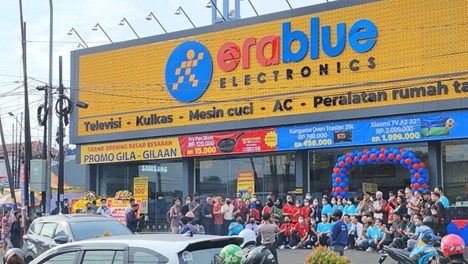
The fifth engine involves margin optimization domestically while exporting the business model internationally, specifically to Indonesia through the EraBlue chain.
Within just three years, EraBlue has scaled to over 200 stores, generating approximately VND 3,700 billion in revenue and achieving profitability in 2025. Indonesia's 280-million population market remains highly fragmented — roughly half still dominated by traditional trade — offering a vast runway for the "full device lifecycle monetization" model to prove its scalability.
For investors, DMX's demonstrated ability to replicate the CLV model beyond Vietnam's borders is a meaningful re-rating catalyst when assessing long-term valuation.
A solid launchpad from the parent company and meaningful room for foreign investors
A notable highlight from the prospectus is DMX's highly concentrated ownership structure. Parent group The Gioi Di Dong (MWG) currently holds 98.955% of charter capital and is expected to retain a commanding 85.08% post-IPO. This provides significant reassurance to investors — affirming that DMX will continue to benefit from MWG's proven governance framework and full ecosystem support to sustain its market leadership in Vietnam's consumer electronics retail sector.
Notably, while the foreign ownership limit (FOL) stands at 49%, DMX's current shareholder base has zero foreign ownership. Given that parent MWG has been near its FOL for years, this IPO represents a rare and timely "golden opportunity" for international institutional investors and funds to gain direct exposure to a sector-leading retailer with a clearly articulated strategy and a double-digit profit growth commitment over the long term.
Valuation perspective: Why DMX's CLV story commands a premium
From the outside, DMX may still appear to be a large, high-growth consumer electronics and mobile retail chain benefiting from technology upgrade cycles. Viewed through that lens alone, valuation would likely remain anchored to the conventional retail sector P/E framework.
But when the five engines above are taken together, the narrative changes fundamentally: revenue and profit are no longer derived solely from hardware sales margins, but also from financial services, technical services, warranty and maintenance revenues, and deferred revenue streams.
Demonstrating the shift from a "sell once" to "sell for a lifetime" model is not merely a compelling strategic narrative - it is the foundation for the market to re-rate DMX at a materially different multiple versus traditional retail chains.
As AI, Windows 11, and 5G catalyze a new device upgrade cycle, DMX is positioned precisely at the intersection of that wave. But more importantly, as the prospectus makes clear, the company does not merely want to capture a single upgrade event - it wants to own both the device lifecycle and the customer spending lifecycle. And that has always been a story that capital markets value at a significant premium.
According to Vietcap Securities' latest research, based on Q1 actual results (49% YoY NPAT growth), 2026 NPAT is projected at VND 9,324 billion, implying a 2026 P/E of approximately 10x. At that earnings level, this is clearly an attractive entry valuation for a sector-leading retailer committed to 16% annual NPAT growth over the next five years.
Source: Vietstock