Addressing Share Liquidity: The DMX Chairman’s Message To Shareholders
At the 2026 Extraordinary General Meeting, Nguyen Duc Tai, Chairman of the Board of Dien May Xanh Investment JSC (HOSE: DMX), explained why trading liquidity in DMX shares is still low. He also outlined two options the leadership is considering to increase the number of shares in circulation.
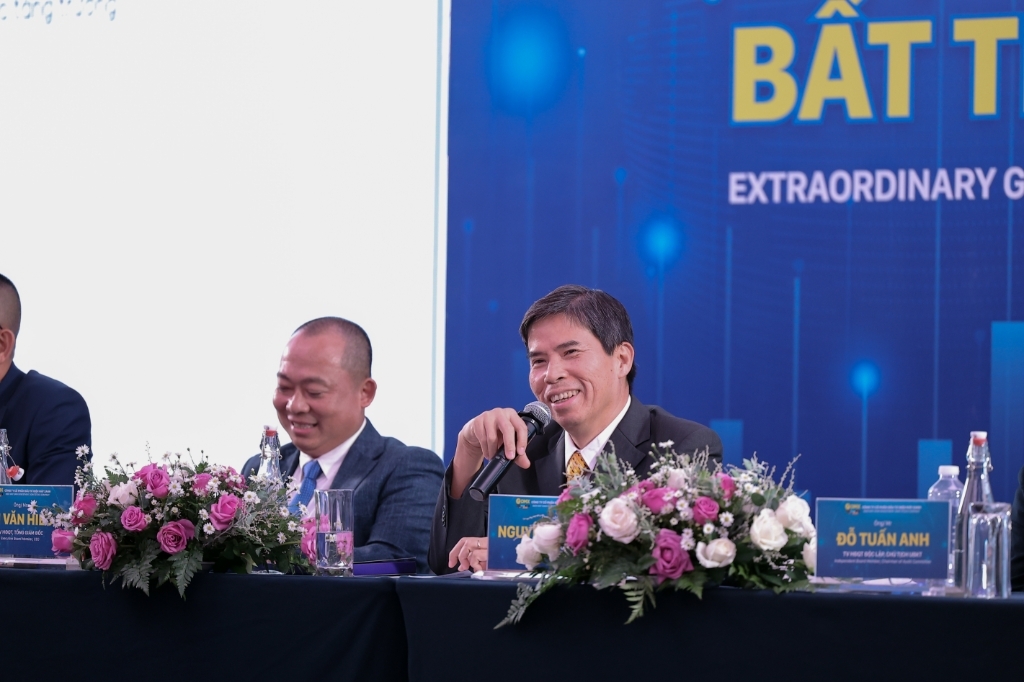 DMX Chairman Nguyen Duc Tai presenting at the 2026 extraordinary general meeting.
On the afternoon of 29 October 2026, DMX held its Extraordinary General Meeting in Ho Chi Minh City. The meeting was attended by 1,210 shareholders representing 1,204,748,479 shares, or 95.03% of total voting shares. During the discussion, a shareholder asked about plans to improve trading liquidity, almost three months after DMX listed on HOSE.
A small number of shares in circulation
According to Mr. Nguyen Duc Tai, low liquidity mainly reflects how few shares are in circulation. The August 2026 IPO sold 166.4 million shares at VND 80,000 per share, about 13% of the company’s total shares. Nearly 90% of those shares went to around 60 domestic and foreign investment funds. The shareholder register dated 5 October 2026 lists 3,839 shareholders.
The Chairman said that with a shareholder base of this size, low liquidity is to be expected. It is also common for newly listed companies. Once the number of shareholders grows several times over, for example from 4,000 to 40,000, liquidity will no longer be a constraint because far more shares will be in circulation.
Two ways to increase shares in circulation
Mr. Nguyen Duc Tai stressed that recognising the cause does not mean the company is standing still. The leadership is considering two options.
First, pay part of the dividend in shares. According to the Chairman, this is the simplest approach. Instead of paying the entire dividend in cash, the company could pay 50% in cash and 50% in shares. This would increase the number of shares outstanding while shareholders still receive the full value.
Second, increase the share of the company held by the public. The leadership is considering raising this share to 20% to 25% over time by offering more DMX shares to the market. That decision rests with the Board of Directors and the General Meeting of Shareholders of the parent company.
The two options work differently. A stock dividend increases the number of shares and makes them easier to trade, but each shareholder’s ownership percentage stays the same. Offering more shares to the public directly expands the free float, which institutional investors and index providers focus on.
A path that takes time
The Chairman said openly that however hard the company tries, this will take several years. He noted that the leadership has been through a similar stage before. He asked investors for patience in the period ahead, as the shareholder base grows from 4,000 to 8,000 and then 10,000 and liquidity improves along with it.
The business behind the shares
Alongside the liquidity discussion, CEO Doan Van Hieu Em presented the following results to the meeting:
- Q3/2026: net revenue was VND 34,180 billion, up 22% year on year. Net profit after tax was VND 2,825 billion, up 105%.
- First nine months of 2026: net revenue was VND 99,460 billion, up 25%, reaching 81% of the full-year plan. Net profit after tax was VND 7,701 billion, up 83%.
- Growth drivers: all five strategic pillars grew. Same-store sales rose 30%, pay-later sales rose 50%, and revenue at EraBlue in Indonesia rose 86%.
- Use of IPO proceeds: the full VND 13,315 billion was used as intended. 99.2% repaid bank loans and 0.8% covered offering costs.
- Full-year 2026 outlook: net revenue of VND 138,900 billion and net profit after tax of at least VND 10,000 billion.
- Direction to 2030: revenue is expected to double and net profit after tax to triple compared with 2025. That implies average annual growth of 15% and 25% respectively, above the 11% and 16% shared at the time of the IPO.
On dividends, the meeting approved, with 100% of votes in favour, a 2026 cash payout of at least 50% of consolidated net profit after tax. This includes an expected interim dividend of VND 2,000 per share in December 2026, following the VND 4,000 per share dividend paid in August.
The meeting also approved a bond-with-warrants programme for 15 key leaders, with 92.55% of valid votes in favour. The right to buy shares depends on profit targets and on DMX’s share price performance against the VN30 Index. The Chairman said the parent company did not vote on this item, so that outside shareholders, who bring an independent view, could decide.
The full meeting minutes and resolution are available at dmx.vn/eng/announcements.